4 Ethics in Obtaining Data
This chapter is in-progress.
4.1 Where do data come from?
Do you generate it? Do you collect it? Do you obtain it?
4.2 What “obtaining data” includes
TK
4.3 Case Study: Census Data
Four original census artifacts…
4.3.1 Census form in 1790
Massachusetts printed schedule used in the 1790 census
Categories: free White males 16 and over, free White males under 16, free White females, all other free persons, and slaves.
4.3.2 Census form in 1850
Categories: name, age, sex, color, occupation, value of real estate, birthplace, married within the year, school attendance, literacy, deafness, dumbness, blindness, insanity, idiocy, pauper status, and conviction.
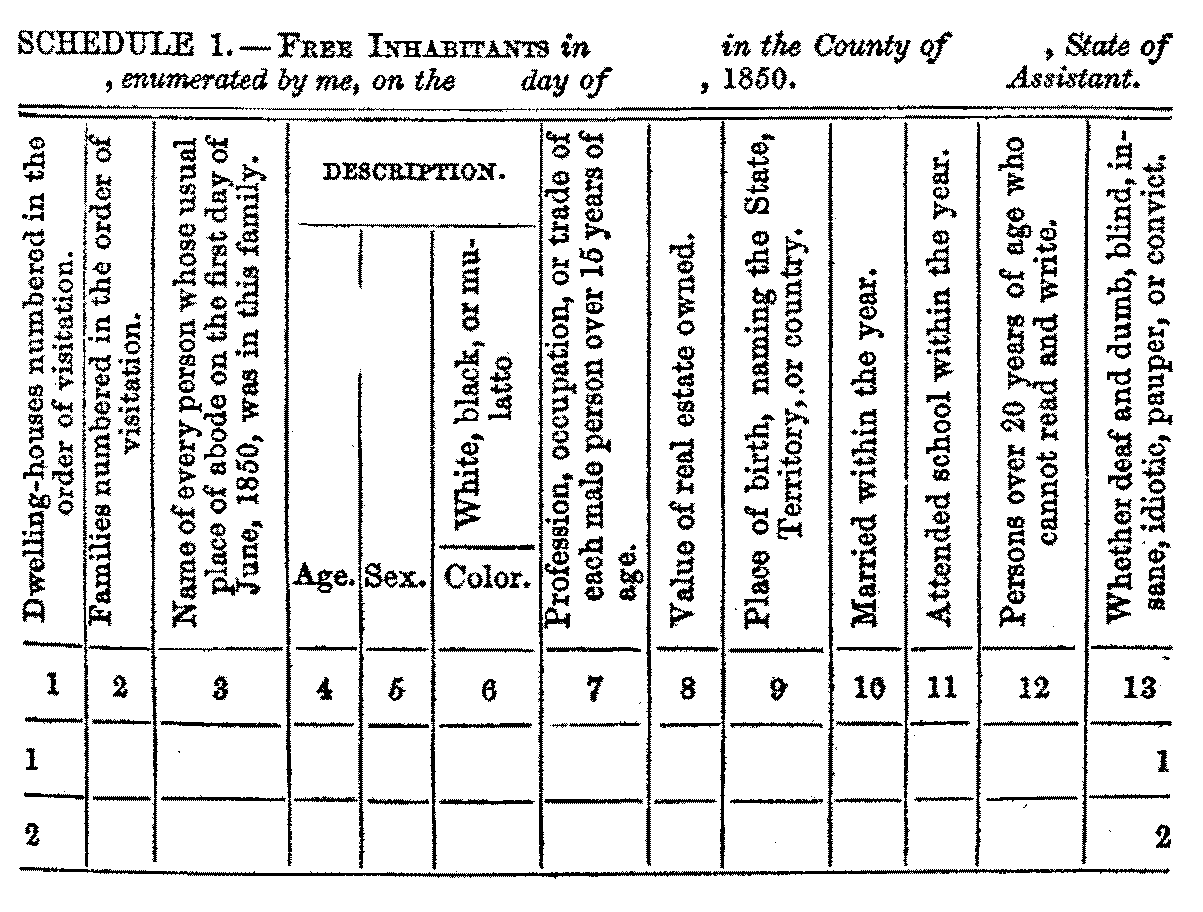
Source: Census Bureau 1850 questionnaire page, direct image file from Census Bureau.

4.3.3 Census form in 1940
Categories: name, relationship, personal description, residence, birthplace, citizenship, education, employment, occupation, income, veteran status, Social Security, and selected supplemental questions for sample respondents.
4.3.4 Census form in 2020
Informational bilingual questionnaire
Categories: household count, ownership or tenure, phone number, name, sex, age and date of birth, Hispanic/Latino/Spanish origin, race, relationship, and whether the person usually lives or stays elsewhere.
4.4 Case Study: Facebook Profile
Similar dynamics can be observed in the Facebook signup process. Until 2014, Facebook had essentially three options: male, female, or no answer. On February 13, 2014, Facebook substantially expanded its gender fields, with 58 different options, custom fields, and additional pronoun settings.
Sources: ABC News, “Here’s a List of 58 Gender Options for Facebook Users” (February 13, 2014), CNN, “Facebook goes beyond ‘male’ and ‘female’ with new gender options” (February 13, 2014)